The ₹2,000 AI Sales Engine
How I made a 300-person sales motion visible — and self-improving — on tools we already owned. The cheap part was never the point.
▶ Watch one meeting run the engine — the interactive floor plan
 Ajay Saini
A rep walks into a brand meeting. Cold. No prior context, no case studies, no read on what the client actually cares about. They pitch, they leave, and the only signal anyone gets back is binary: it closed, or it didn't. When it didn't, the explanation was always the same — "the brand wasn't interested" — and there was no way to verify it and nothing to learn from it.
That was my monetization team before Project Kaizen: a 300-person engine where the most important thing — what actually happens inside a pitch — was invisible. This is how we made it visible, for less than the cost of a team lunch.
The bet: stop asking, start observing
I have a controversial opinion: if you have to nag your sales team to update the CRM, your process is broken — not your people.
It's the classic CRM paradox. I wanted visibility — to forecast revenue, understand customers, make decisions. My reps wanted less admin so they could actually sell. The result was garbage data, and "how did the meeting go?" became a subjective guess instead of an objective fact. Asking people to report reality is always fragile; the system has to capture it instead.
So we built one that does. We wrote our own meeting bot — cheaper than the off-the-shelf options and better at Indian languages — that passively joins calls, records, and transcribes. Zero manual data entry. We capture the truth, not the rep's memory. I called it Kaizen — Knowledge & AI-based Sales ENablement, named for the Japanese principle of continuous improvement. The name is the thesis: an engine built to solve a behavioural problem, not just a technical one.
Capture reality. Don't ask for it.
The anatomy
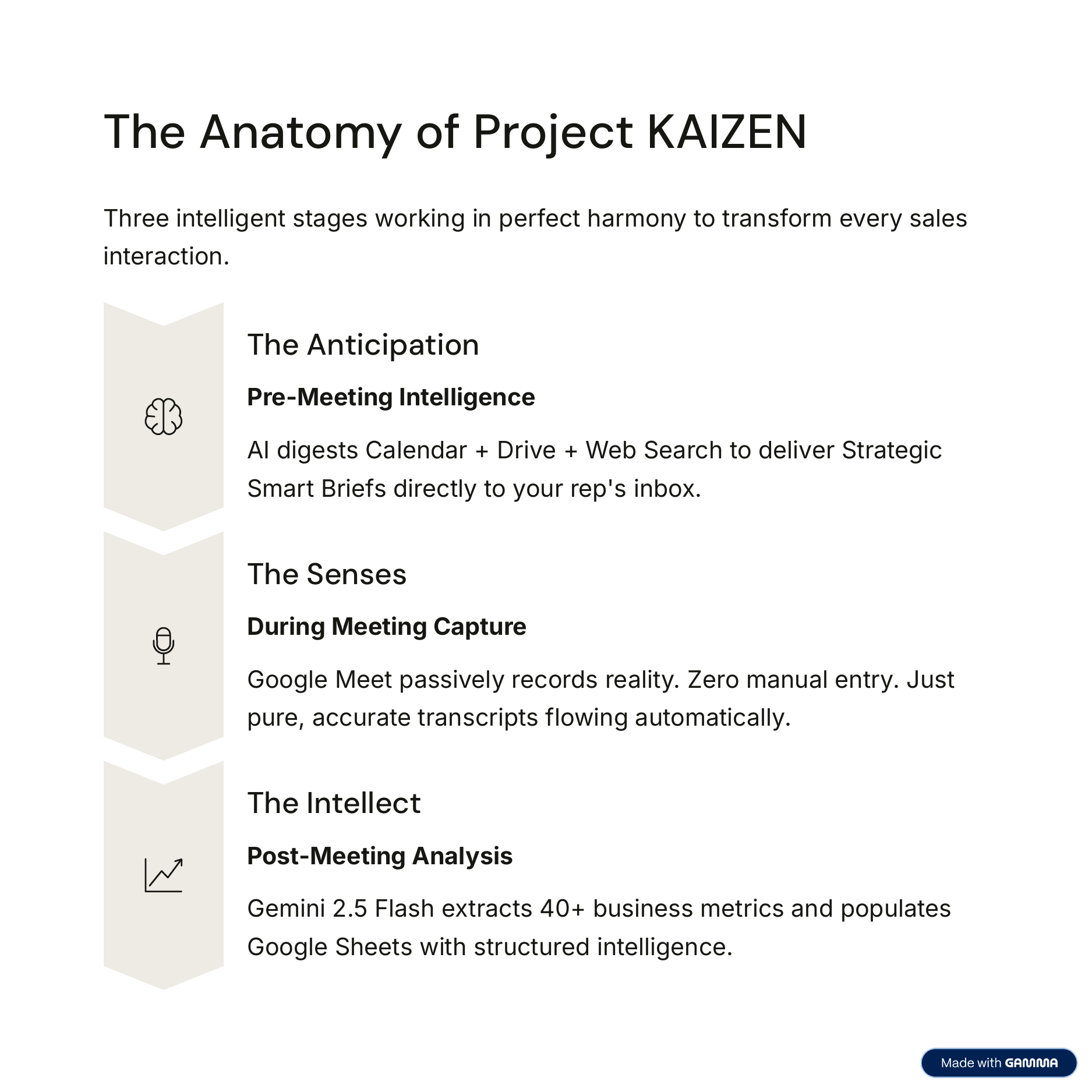
The backbone isn't exotic. It's Google Workspace — Calendar, Gmail, Drive, Sheets — APIs we already paid for, with Python as the connective tissue and an LLM doing the synthesis. Three stages:
- Anticipation. A briefing agent digests scattered context — client history in Sheets, case studies in PDFs, brand news on the web — into one pre-meeting brief, emailed to the rep before the call.
- Senses. The system passively captures and transcribes every meeting. No manual entry.
- Intellect. The transcript goes to the model, which extracts 40+ structured metrics — budget, pain points, pitch score — written straight back into Sheets.
The economics: it launched on ₹0 infrastructure (already in Workspace) and ~₹1,690/month of AI compute — under ₹3 a meeting. As it grew into the layers below, the run cost grew with it: today the whole engine — capture, briefs, analysis, creatives, dashboards — runs at roughly ₹30–35k a month across ~600 analyzed meetings (May 2026), still about ₹50 to turn a black-box conversation into structured market intelligence. But the cheap part was never the point.
The journey, in three phases
1 — Capture reality (don't ask for it). We deployed the bot and hit 92% adoption within weeks in our digital-first teams, precisely because it was passive — zero disruption to how reps work. Offline was the hard part; today physical meetings flow into the same pipeline through recorded uploads. For the first time, hundreds of hours of conversation a month were visible: data, not memory.
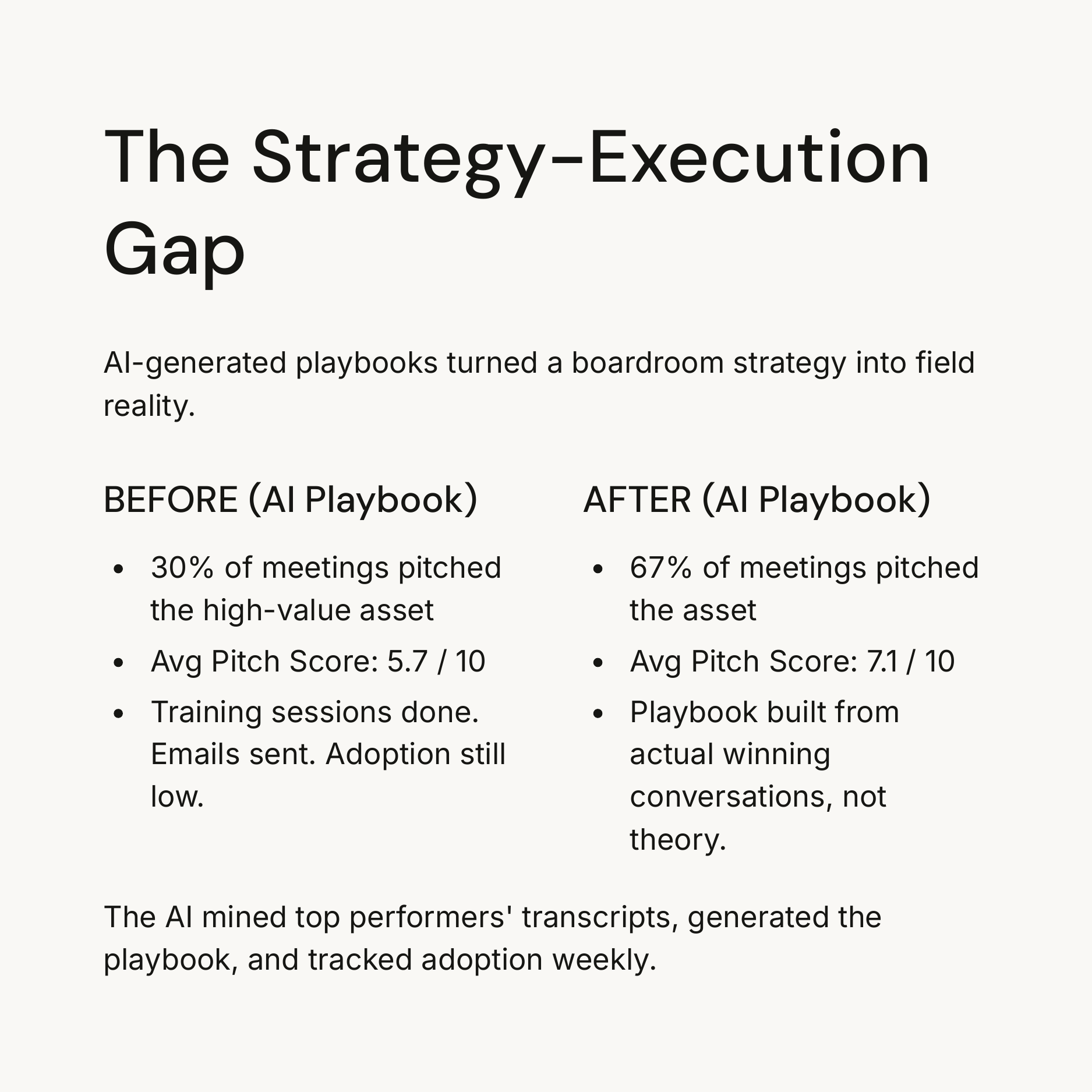
2 — Analyze, then act. The data surfaced what we'd never been able to see: our highest-value asset was pitched in only 30% of meetings — despite the training, despite the "please pitch this" emails. So instead of another email, we mined our top performers' transcripts and generated a playbook from actual winning conversations, not theory — then tagged every meeting for whether the asset was pitched. Adoption more than doubled to a 66.7% peak, and holds in the mid-50s today — keeping it there is precisely what the coaching loop is for. The pitch-quality score with that asset: 7.1/10, versus 5.7 without. Not a mandate. Evidence.
3 — Empower before the meeting. Pre-meeting briefs now generate from the calendar invite: brand background, past-meeting history, relevant case studies, the questions the client is likely to ask. Reps arrive knowing what to expect and how to position. Post-meeting minutes, with pitch ratings, write themselves.
The closed loop — the part that compounds
Here's what isn't obvious unless you trace it:
The system captures meetings → analysis surfaces what good selling looks like → we train the team on it → that proof becomes a case study in the brief library → the brief surfaces it to the next rep before their meeting → they close → their close becomes the next case study.
The data doesn't just tell us what happened. It becomes the training material that makes the next meeting better. The system compounds on itself. One example: a cold brand, no prior relationship, closed in 36 minutes — the brief had predicted four of the four questions the client asked and surfaced exactly the proof point that won the room. The rep walked in as an advisor, not a vendor. No manager in the room.
What it's grown into (July 2026)
The three-stage engine was the seed. Eighteen months of compounding later, the same meeting base — over 6,000 analyzed conversations — has grown rings around itself:
- The CRM built itself. The paradox from the top of this piece resolved the honest way: we never made reps fill a CRM — the meeting layer became one. Every conducted meeting, physical or digital, lands as a structured record; pitch behaviour is captured on 96–99% of them.
- Email joined the meeting layer. Brand email threads now feed the same intelligence — classified for stage, sentiment and response-time — so the funnel is visible between meetings, not just inside them.
- Clients see it too. Alongside Kaizen, the same small team shipped a brand-partner portal — live campaign reporting that replaced emailed decks — and an API that streams qualified leads straight into brand CRMs.
- It writes our market map. Per-industry customer profiles and objection playbooks are mined directly from hundreds of real meetings per industry — the questions clients actually ask, answered from campaigns we actually ran — and a competitive-intelligence layer scores market penetration from the same base.
- The team rates it. In the structured survey we ran with the sales team: 86.4% favorable, 4.4/5 on the core workflows.
- The pattern is spreading. Our society-acquisition org is now replicating it — demo transcription, pitch ratings, and a map-based beat-planning app of its own. The engine turned out to be a template.
Coaching, at scale
The macro story is adoption. The one I'm prouder of is the micro. We fed each rep's own meetings — 8 to 20 of them — back through the engine to find the patterns they couldn't see, and turned it into a personalised Pitch Improvement Plan. Not a report card; a coach built from their own conversations:
"Reactive information-sharing in 8 of your meetings — you wait for the client to ask for data instead of leading with it." · "You pitched awareness when the client wanted performance marketing." — with a 21-day plan and before/after scripts.
The results weren't subtle: one rep went from 33% to 58% on the audit parameters, another 27% → 60%, a third 29% → 48%. The way a colleague put it stuck with me: AI doesn't replace the sales manager — it gives the manager an army of analysts, coaching every rep at once.
The honest part
I want to be straight about attribution, because the rest only means something with it. Execution growth has many levers — team additions, pricing, seasonality, focus. I won't claim the whole number for Kaizen. What I can claim cleanly:
- Premium-inventory pitch adoption: 30% → 66.7% at peak, mid-50s sustained (May 2026) — direct: data → training → behaviour change
- New outbound brand relationships: 0 → 30 in the first campaign (Q1 2026) — the outbound motion is now being rebuilt around customer profiles mined from the meeting base
- Pre-brief prediction accuracy: 4-for-4 across the two documented closures
- Meeting-quality visibility: 0 → 40+ metrics per meeting, on 6,000+ meetings
- Pitch-quality score on the key asset: 5.7 → 7.1 / 10
The broader growth is real, but the honest framing is that Kaizen is one input — not the only one.
Why it's different from every other growth lever
Manager coaching scales with manager time; this scales without it. Training sessions decay; this is continuous — every meeting is a data point. Incentives drive the outcome, not the skill; this drives the skill, which drives the outcome. New hires need ramp time; this makes the team you already have better, faster. Mandates create compliance; this creates capability, through evidence.
My job now: governor, not operator
The early phase needed me — defining which 40 metrics to extract, what "good" looks like, how to sequence the capability-building. That's business judgment; I couldn't have handed it off cold. That phase is done. Day-to-day, a small crew of AI-native operators runs the engine; my job now is direction and the quality bar — decide where to point it next, audit what it surfaces, and hold the line on accuracy. One intern in that environment became an AI-native product manager, building a lead-routing system into brand CRMs; a closure-prediction pilot came out of the same data. The system even builds its own onboarding material. The honest lesson of the governor role: the instruments matter more than the hours — a weekly review rhythm, quality checks on the outputs, and a scoreboard that says whether the numbers are on pace. That's where my time goes.
The point
AI isn't just chatbots — at its most useful it's the difference between managing by feel and managing by facts, and you don't need a big budget or a data team to get there. Capture reality instead of asking for it, and close the loop so every result makes the next one better.
The ₹2,000 was never the headline. The headline is that one person can make three hundred people better — without being in the room.